

Open any of your brand’s social accounts right now and check the last ten posts. Some of them did fine. A couple flopped for no reason you can point to. One, probably the one you almost didn’t post, took off.
That’s not bad luck. That’s the algorithm making a decision about your content in milliseconds, and most brands in the region are still guessing at the rules instead of reading them.
Here’s the full picture how these systems actually work, what changed to get us here, what each major platform is really scoring, and what it means for how DALI builds content for our clients.
A SHORT HISTORY OF WHY YOUR FEED ISN’T CHRONOLOGICAL ANYMORE
It wasn’t always like this. The earliest social feeds SixDegrees, MySpace, Facebook in its first two years showed you posts in the order they were published. Simple, predictable, and easy to plan around.
That changed in 2006, when Facebook launched the News Feed and introduced the idea that a feed could be curated rather than chronological. By 2010, Facebook had gone public with the mechanics behind it EdgeRank, a formula that scored content on affinity, weight, and time decay. A year later, EdgeRank itself was retired in favor of more sophisticated, machine-learning-driven ranking, and every major platform that followed built on that same premise: don’t just show people what’s newest, show them what they’re most likely to actually want.
Twenty years later, nearly every platform of scale runs on some version of that logic. Bluesky is the one notable holdout, defaulting to a chronological timeline more on that below.
WHAT AN ALGORITHM IS ACTUALLY DOING
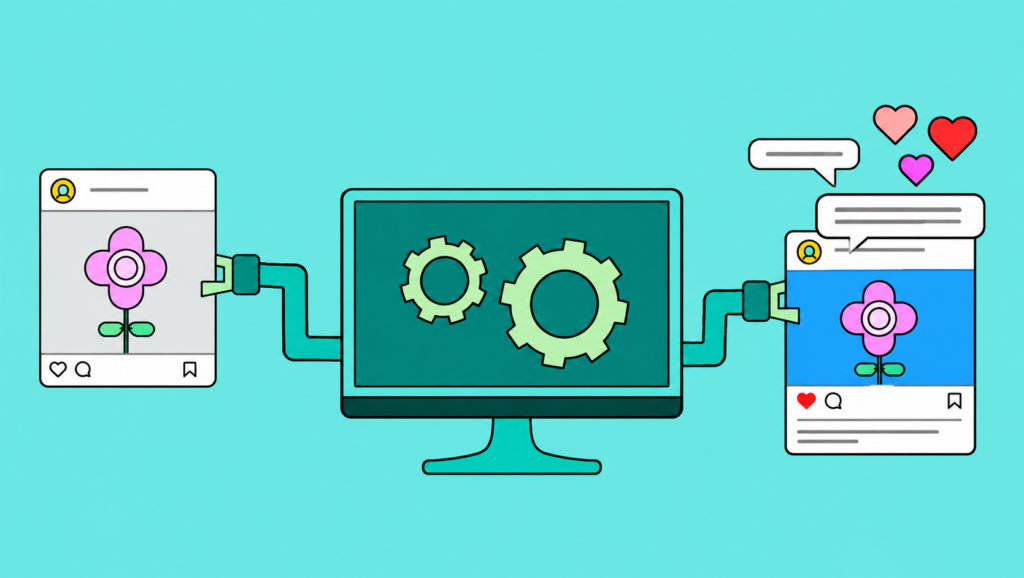
Every major platform’s ranking system follows roughly the same four-step process, and it happens in the time it takes someone to open the app:
- Gather everything that's eligible to show a given user posts from accounts they follow, plus (on most platforms) content from strangers, filtered for policy violations
- Evaluate each piece of content against dozens of signals
- Predict, using machine learning, how much value this specific post will create for this specific viewer
- Rank and serve the results, then repeat the whole process on the next scroll
Instagram, for example, narrows an eligible pool down to roughly 500 posts before it even starts scoring relevance for your feed. That’s happening for every user, every few seconds, all day.
The upshot: reach isn’t really about your follower count anymore. It’s about whether the algorithm believes this specific post is worth showing to this specific person which is good news, once you understand what it’s actually scoring.
THE SIGNALS EVERY PLATFORM IS WATCHING
Strip away the platform-specific branding and the same handful of signals show up almost everywhere:
- Watch time: how long someone actually stays on your content, not just whether they scrolled past it
- Engagement rate: likes, comments, and shares measured against how many people saw the post, not against your follower count
- Relevance: how closely your content matches what this person has already shown interest in
- Interaction history: whether this specific viewer has engaged with your brand before, and how recently
- Content freshness and format: platforms consistently push whatever format they're trying to grow, which right now still means short video
- Trend and keyword signals: captions, on-screen text, and audio are read and matched to what's trending right now
- Content quality and policy compliance: technically sound uploads (resolution, no watermarks, no policy strikes) get a fair shot; flagged content gets suppressed before it's even scored on the rest
Notice what’s not on that list: production budget. A phone-shot video that holds attention for twenty seconds will consistently outrank a beautifully lit ad that gets skipped in two.
PLATFORM BY PLATFORM: WHAT EACH ONE IS ACTUALLY REWARDING
This is where most brands get it wrong; they run one strategy across every platform. Each one is optimizing for something slightly different, and a few go deep enough to be worth understanding surface by surface.
INSTAGRAM doesn’t run one algorithm; it runs at least four, one each for Feed, Stories, Reels, and Explore, and they don’t weigh things the same way.
In the main feed, the biggest split is connected vs. unconnected reach. For people who already follow you, likes carry the most weight. For people who don’t, a “send” someone caring enough to DM your post to a friend matters more, because it’s a stronger signal of genuine value than a passive tap. Feed ranking also looks at how long someone tends to scroll after opening Reels, how they’ve behaved with posts of a similar age, and whether they typically spend real time with your account specifically.
Reels are scored on their own terms: the likelihood someone watches to 95% completion, the likelihood they bail in the first three seconds, and whether the audio gets reused by others. Stories weigh how often someone taps through to view yours versus skipping, and Explore looks at whether a viewer is likely to follow your account off the back of one video.
Practical read: a single asset posted identically to Feed, Reels, and Stories is being judged by three different scorecards. Cut and caption for each.
Facebook’s approach is less a fixed hierarchy of signals and more a model of “typical behavior” it treats a heavy commenter and a silent scroller as different problems entirely. It weighs your connections (friends, groups, pages you’ve liked), the content format you tend to engage with, predicted likelihood of a like/comment/share, and relevancy signals like whether you tend to visit certain pages or read comment threads all the way down.
TIKTOK inverts the usual logic. Most platforms are built to show you more of what you already follow; TikTok is built for discovery from strangers, and it’s extraordinarily good at it — the For You Page accounted for over 70% of all video views on the platform by late 2025. That means a brand-new account with the right hook can genuinely outperform an account with ten thousand followers.
The FYP is driven by user activity (likes, comments, favorites, follows, watch time, and what you’ve marked “Not Interested”), video metadata (captions, on-screen text, audio choice, hashtags), account settings like language and location, and critically trend signals, especially trending audio.
LINKEDIN has been pushing harder toward video and relevance over raw virality through 2025 and into 2026. It rewards original, expert-level content, penalizes spam signals (grammar errors, hashtag stuffing, posting more than once every twelve hours), and puts enormous weight on the first hour after you publish that window determines the trajectory the post gets for weeks afterward. Comments with real substance and shares outweigh simple reactions.
YOUTUBE optimizes for one thing above all: keeping people on the platform. Watch time and session duration matter more than any single video’s individual performance, and the algorithm actively learns from what you don’t watch, gradually suppressing content types you consistently skip. On top of behavioral signals, classic YouTube SEO titles, thumbnails, descriptions, topic relevance still meaningfully affects discovery. YouTube remains the second-largest social platform globally, with more than 2.7 billion monthly active users.
How the major platforms rank content in 2026
| Platform | Top Ranking Signals | Preferred Format | Chronological Option? |
| Watch time, likes, sends | Reels, carousels | Yes | |
| Predicted engagement, connections | Video, photos | Yes | |
| TikTok | Watch time, user activity | Short-form video | No |
| Content quality, early engagement | Text, documents, video | No | |
| YouTube | Watch time, relevance | Long and short video | No |
| X | Connections, recency | Text, images | Yes (Following tab) |
| Threads | Predicted engagement, view time | Text | Yes (Following tab) |
| Visual relevance, saves | Images, Pins | No | |
| Bluesky | User-controlled, community | Text | Yes (default) |
| Upvotes, recency, community moderation | Text, links, images | Yes (New sort) |
STOP TRYING TO “BEAT” THE ALGORITHM
Every few months a new “hack” makes the rounds to post at this exact hour, use this many hashtags, comment on your own post immediately after publishing. Most of it is noise, and platforms actively penalize anything that reads as manipulation.
The accounts that consistently win aren’t the ones gaming the system. They’re the ones that treat the ranking signals as a description of what a real audience actually wants: content worth watching to the end, worth sending to a friend, worth commenting on with something more than an emoji. Build for that, and the algorithm rewards you as a side effect not the other way around.
Context worth keeping in mind: globally, people now spend an average of 141 minutes a day on social media, and roughly two-thirds of US consumers already use social platforms as a search engine before they use Google. Attention and discovery are both happening inside these feeds. If your content isn’t built for how each one actually ranks, you’re not just losing reach you’re losing the search traffic too.
WHAT THIS MEANS FOR YOUR NEXT CAMPAIGN
Before your next content calendar goes out, run it against these questions, platform by platform:
- Is this piece built for the specific surface it’s going on Feed vs. Reels vs. Stories, Following vs. For You or just reposted identically everywhere?
- Does the first three seconds earn a reason to keep watching?
- Is there anything here worth a comment, a save, or a send not just a scroll-past like?
- If this is going on LinkedIn, do you have a plan to drive real engagement in the first hour?
- If this is going on TikTok, are you leaning on trend and audio signals, or fighting the platform’s discovery-first design?
If the honest answer to any of those is no, the algorithm already knows and your reach will show it.
At DALI, this is exactly the gap we close for our clients: platform-native content strategy built on how each feed actually ranks, not on guesswork or recycled “best practices.” If your brand is ready to stop posting into the void and start winning the feed, let’s talk.
Talk to our team
Write email
info@dali-agency.com