

Why Traditional SEO Is Dying And GEO Is Replacing It (A 2026 Guide for MENA Brands)
A few years ago, getting your brand seen online followed a simple recipe. Write blog posts. Stuff in the right keywords. Climb to the top of Google. Wait for traffic. For a long time, that formula genuinely worked, and entire marketing teams across the Middle East and North Africa built their playbooks around it.
That era is closing. Not slowly, and not quietly.
The way people find information has changed at a fundamental level, and most brands in the region haven’t caught up. Many are still running SEO strategies designed for 2018 while their customers have already moved somewhere else entirely. The gap between how brands publish and how people actually search has become a chasm and that gap is precisely where the opportunity, and the risk, now live.
This guide breaks down what’s actually happening, why traditional SEO is losing its grip, what Generative Engine Optimization (GEO) really means, and what MENA brands should do right now to stay visible in a search landscape that no longer revolves around blue links.
How People Actually Search Now
Think honestly about your own behavior for a moment.
When you want a skincare recommendation, do you open a random blog and read 1,500 words of filler before reaching the actual advice? Probably not. You watch a review on TikTok. You scroll the comments. You ask ChatGPT to compare two products. You search Reddit for unfiltered opinions. You check Instagram to see what real people are using. Only later if at all do you visit a brand’s website.
That’s not unusual anymore. That’s the default.
Search has become more human. People now trust conversations, creators, and lived experiences far more than polished, optimized articles. They want to hear from someone who actually used the product, not from a page engineered to rank for a phrase.
Several shifts are happening at once:
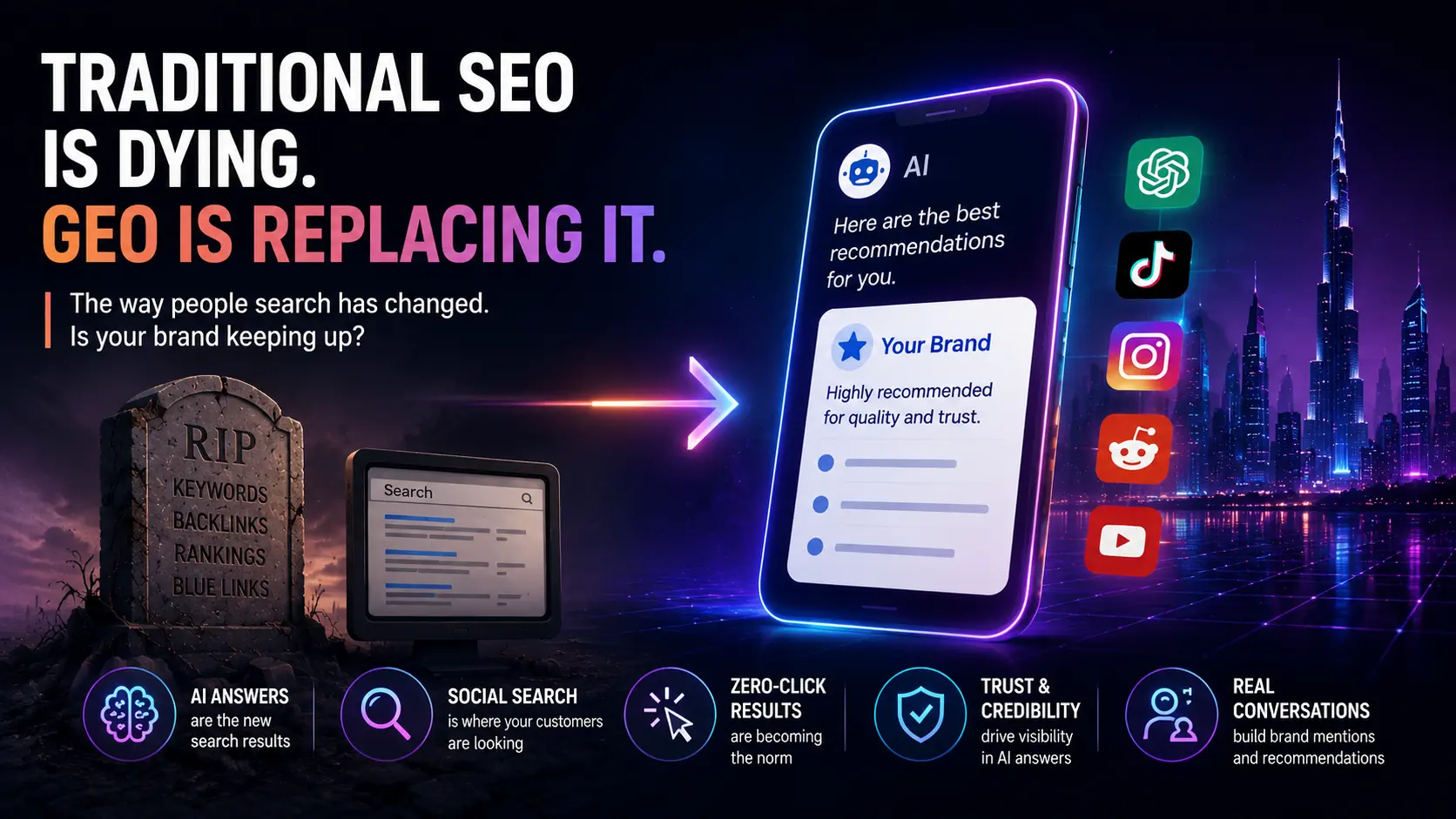
- People ask AI assistants instead of opening Google. ChatGPT, Gemini, and similar tools have become the first stop for questions that used to start with a search bar.
- Social platforms have become search engines. A large share of younger users now search directly on TikTok and Instagram before they ever touch Google, especially for products, restaurants, and recommendations.
- Zero-click answers dominate. Even when people do use Google, they frequently get the answer directly from an AI-generated summary at the top of the page and never click through to any website at all.
The implication is uncomfortable but important: you can rank perfectly and still be invisible, because the user got what they needed without ever seeing your link.
Ranking First No Longer Means You Win
This is the part many businesses still haven’t fully absorbed.
The old question was: “How do we rank number one?”
The better question now is: “How do we become a brand that people and AI systems trust enough to mention?”
Those are not the same goal, and the difference matters enormously. AI tools don’t simply reward keyword density anymore. When they generate an answer, they weigh signals that look a lot more like reputation than like traditional SEO. They care about:
- Credibility: does this brand actually know what it's talking about?
- Real mentions: is this brand referenced across the web by independent sources?
- Authority: is there a body of substantive, expert content tied to this name?
- Reviews and social proof: what are real customers and creators saying?
- Genuine conversations: does the brand appear in forums, threads, and community discussions?
- Useful insight: does the content offer something a reader can't find in fifty identical articles?
You can still find pages sitting at the top of Google built on robotic, lifeless writing. But users have stopped engaging with that content, and AI systems are getting noticeably better at recognizing and discounting it. Ranking is now a step in the process, not the finish line.
The Problem With Most SEO Content Today
Open almost any “optimized” article right now and you can feel within seconds that it exists only to rank.
The same structure. The same hedged, say-nothing phrasing. The same advice everyone has already read a hundred times, reworded just enough to seem original. After AI writing tools exploded, the internet flooded with content that technically forms sentences but communicates nothing. It checks every box on an SEO template and leaves the reader with exactly zero new understanding.
Readers feel this instantly. So, increasingly, do the algorithms.
In MENA specifically, a damaging pattern took hold: brands began mass-producing AI blog posts on the assumption that more content automatically equals more traffic. The logic seemed sound — publish twenty articles a month, capture more keywords, win more visits. But the opposite has been happening. Volume without substance dilutes a brand rather than building it, and search engines have grown sharper at separating depth from filler.
The brands genuinely growing right now are moving in the other direction. They produce:
- Strong, clearly-stated opinions instead of neutral summaries
- Real stories drawn from actual experience
- Genuinely educational content that teaches something
- Creator-led content that carries a human voice
- Active community engagement rather than one-way broadcasting
- Content with personality that's recognizably theirs
In other words, less keyword filler and more reason to be remembered.
So What Exactly Is GEO?
You’re going to hear this term constantly throughout 2026.
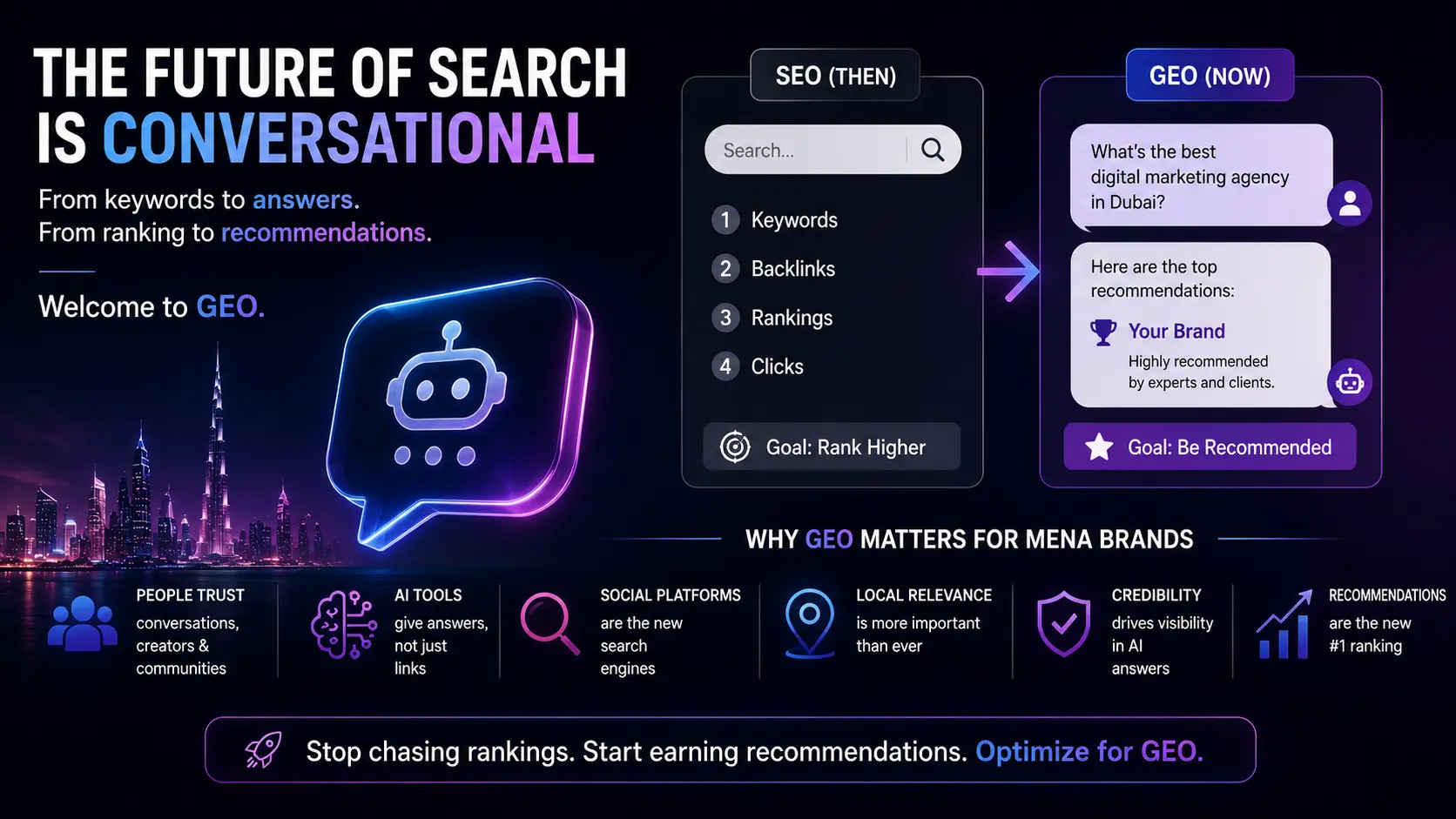
GEO stands for Generative Engine Optimization. Where SEO optimizes your content to be found by search engines, GEO optimizes your brand to be surfaced, cited, and recommended by AI-generated answers.
The distinction matters because of where AI tools actually get their information. When someone asks ChatGPT or Gemini something like “best marketing agency for restaurants in Dubai” or “top fashion brands in Saudi Arabia,” the model doesn’t simply read your website and rank it. It synthesizes an answer from trusted signals scattered across the entire internet.
Those sources include:
- Editorial articles and publications
- Customer reviews
- Social media discussions
- Mentions from creators and influencers
- Interviews and podcasts
- PR coverage
- Forums like Reddit and niche community boards
- Ongoing public conversations about your brand
This means visibility today is far bigger than Google alone. Your reputation is being assembled from dozens of places at once, and AI tools are reading all of them. A single great blog post on your own domain is now just one small input among many. The brands that get mentioned by AI are the ones that show up credibly and repeatedly across this wider web.
SEO vs. GEO at a glance
Dimension | Traditional SEO | GEO (Generative Engine Optimization) |
Primary goal | Rank high on search results pages | Get cited and recommended in AI answers |
Core signal | Keywords, backlinks, on-page structure | Credibility, mentions, authority, real conversations |
Content style | Optimized for crawlers | Written for humans, trusted by machines |
Where it lives | Mostly your own website | The entire webreviews, social, PR, forums |
Success metric | Click-through and rankings | Brand mentions and AI recommendations |
Winning brands | Whoever games the algorithm best | Whoever builds genuine recognition |
GEO doesn’t replace good content fundamentals it raises the bar. The technical hygiene of SEO still matters, but it’s no longer sufficient on its own.
Why This Shift Matters So Much in MENA
Here’s the genuinely interesting part for brands in this region: most of them haven’t adapted yet. And that lag is an opening.
Many industries across MENA still lack strong authority content the kind of substantive, expert, trustworthy material that AI systems lean on when building answers. The shortage is even more pronounced in Arabic. While English-language markets are already crowded with brands competing for AI visibility, much of the Arabic web remains thin on genuine authority content, leaving the field wide open.
A large number of regional businesses are still posting generic designs, recycled captions, and blog posts that read like they were generated in bulk and never edited by a human. There’s very little real opinion, very little original insight, and very little personality.
That creates a clear advantage for whoever moves first. Brands that begin building authentic authority today in both Arabic and English are positioned to dominate their categories as AI-driven discovery becomes the norm. Not because they outsmarted an algorithm, but because they became genuinely recognizable while everyone else was still recycling captions.
The window for this advantage is widest right now and narrows every month more competitors wake up.
The Brands Winning Right Now Feel Human
Look at the brands people in the region actually remember and talk about. They tend to share a set of traits:
- They have a distinct personality and voice
- They create relatable, culturally-aware content
- They genuinely engage with their audience instead of broadcasting at it
- They understand local culture and reflect it authentically
- They know how to tell a story rather than just list features
- They feel present and alive online, not automated
- Forums like Reddit and niche community boards
- Ongoing public conversations about your brand
What MENA Brands Should Focus On Instead
If there’s one mindset shift to take from all of this, it’s this: most brands don’t need more content. They need better content.
Instead of publishing twenty forgettable blog posts every month, redirect that energy toward fewer, stronger assets that actually build authority and earn mentions:
- Original insights. Share data, observations, or perspectives that don’t already exist in a thousand other articles. Originality is what gets cited.
- Creator collaborations. Partner with voices your audience already trusts. Their mentions feed directly into how AI tools assess your credibility.
- Educational video. Teach something genuinely useful. Video carries personality and earns engagement that text alone rarely matches.
- Founder and team stories. Put real humans forward. People connect with people, and authentic voices are hard to fake or mass-produce.
- Customer experiences and case studies. Real outcomes from real clients are among the strongest trust signals you can publish.
- Strong brand positioning. Decide clearly what you stand for and say it consistently. A recognizable position is what makes you mentionable.
- Active community engagement. Show up in the conversations where your audience already gathers forums, comment sections, social threads.
And underneath all of it, the single most important principle: write like a human being. People are exhausted by content that sounds generated, and nowhere is that fatigue sharper than in creative industries like marketing, where the audience can spot a hollow article in seconds.
SEO isn’t vanishing. The technical foundations site health, clear structure, relevant content still matter and will continue to. But the old version of SEO, the one built on keyword stuffing and content volume for its own sake, is steadily losing relevance.
The future belongs to brands that people trust, recognize, and actively talk about both across the open web and inside the AI platforms that increasingly shape what gets discovered. For MENA brands, this transition is still in its early innings, which is exactly why it’s such an opportunity. The businesses that adapt now, building real authority and a genuinely human voice, are the ones most likely to be the visible, recommended, and trusted names tomorrow.
The question is no longer just how do we rank. It’s how do we become the brand worth mentioning.